Monday, January 31, 2011

Beauty, Technology, and Colors in Motion™


Early modern dance artists wove multiple and sometimes seemingly contradictory influences into their dance works. For instance, they used terms such as “natural” to describe the style of their movement and advocated for a relationship between the human body and nature, celebrating seasonal cycles and an idealistic, perennial philosophical perspective.
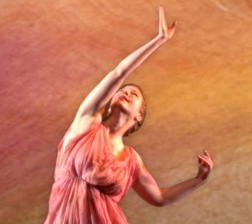
"Sky," collaboration with Linda DeHart
Yet, at the same time, they incorporated some of the newest scientific theory and technological advances into their performance presentations.  Loie Fuller created fantastical moving images through innovations in costume technology and lighting design and influenced Duncan’s use of side lighting and warm colors.  Duncan may have mothered a “natural” dance technique, but she used contemporary scientific metaphors as evidence to support her argument for a movement technique based on the physics of the human skeleton, efficient movement patterning, and harmonious proportions.

We know that Duncan was inspired by natural forces, like the wind in trees and ocean waves, but Duncan did not limit her understanding of wave movement to visible manifestations of the phenomena. “All energy expresses itself through this wave movement,” she wrote, “For does not sound travel in waves, and light also?” (Duncan, The Art of the Dance). Duncan advocated rediscovering the embodied knowledge of the ancient Greeks, and, at the same time, she used contemporary physics metaphors to describe her dance art.

Shooting green screen footage for CIM
At the turn of the twenty-first century, we are again (or still?) in the midst of a technological revolution (evolution?). Our lives are being continually transformed by mobile technology, the internet, and digital media.  We are constantly bombarded by digital media and sound bytes, pecking at our attention, fracturing our consciousness, and encouraging us to give in to whirlwind multi-tasking and the accompanying high-stress high.

Is there any way to utilize these new technological mediums for meditative and restorative ends? To create beauty in the world? This is the question posed by the creative team of Colors in Motion™, spearheaded by visual artist Linda DeHart, a veteran creator of large-scale public art commissions and longtime practitioner of Noyes Rhythm (for more context on Noyes, check out October’s post “Forest Breathing in Nutley, NJ”).  DeHart’s latest project embraces the potential of new media to create atmosphere and transform space—and to do so with the goal of slowing people down, encouraging them to breath, and inviting them into an experience of tranquility, peace, and beauty.

Teaming up with artists from a variety of mediums, including filmmaker Christopher Graefe, poet Jeff Volk, composer Josh Hummel, me as dance artist, and arts integrator and Noyes Rhythm practitioner Susan Bayley, DeHart and Colors in Motion™ are crafting visual and sensorial art experiences that heal and transform. These multimedia experiences are effective on the small screens of phones and computers and are awe-inspiring as large-scale, full-wall architectural installations. Check out the Experiences page of Colors in Motion™ for samples of this innovative work or subscribe to receive monthly online experiences through Touchstone, art that changes people’s moods in public spaces.

Monday, January 24, 2011

Duncan Dance, Pedagogy, and a Progressive Perspective


We know that education, not just dance education, was supremely important to Isadora. She envisioned dance as a vehicle for revolutionizing general education and as the means for educating the whole person, from a developmental perspective.  One aspect of the legacy of Duncan dance is the idea that every body has a right to experience the joy and freedom of expressive movement. Duncan envisioned the freedom to dance as a human right. Now that would be a pretty radical platform for a human rights organization!

Winter Workshop, Nia Moves, Houston
When I was a grad student at the University of Texas at Austin, we read an excerpt from sociologist Barbara Ehrenreich’s Dancing in the Streets: a History of Collective Joy. Although critics of the book cite her lack of engagement with the work of contemporary dance history scholars and theorists, she does present a compelling portrait of the power and potential danger inherent in the unconstrained bodily movement of the masses. Most interesting is her observation that dance movement can be contagious and, in some cases, it can be hard to stop.  Duncan certainly waxes eloquently about the element of Dionysian ecstasy she experienced through the dance, and her idea that dance movement can create an altered and uplifted state of consciousness pervades many contemporary ecstatic movement practices.

Student, Winter Workshop
And yet, there is kind of an irony in Duncan dance—the work advocates for universal access to the tools of expressive movement, but the technique itself is quite specific and not necessarily easy to execute. That doesn’t mean it is inaccessible to a wide range of bodies, experience levels, and ages, but it does mean that there is a specific way Duncan coordinated movement in her dances and that daily practice, or training over time, is required to fully embody the movements in her choreographies.

It was this paradox of Duncan dance that I held in mind when my cousin Bill asked me whether I envisioned training a select, privileged few to dance the movement to perfection or whether I would rather share this dance work with the masses. Of course, he already had presumed a specific answer when he posed the question (after dubbing me an evangelist of Duncan dance, he was advocating for the teach-the-masses approach).  Bear in mind, this was after I found out that we share an ancestor who died, as a public figure, in the midst of giving a speech about the importance of well-funded public education, so I suppose I might come by my bent towards educational evangelism honestly!

Winter Workshop, Nia Moves, Houston
I do want to share this work with a broad swath of people, and I very much come from an egalitarian perspective when it comes to this work. Yet, I also have deep respect for the subtlety and integrity of Duncan’s dance technique. Having taught a smattering of guest artist residencies and one-time workshops, I realize that I need to cultivate a space to teach this work to an adult population on a more regular basis. There is just so much depth in this movement work, and to teach an introductory class barely scrapes the surface.

Student, Winter Workshop
It was so gratifying to share this movement last weekend in Houston—and to have such a great workshop turnout and with so much interest expressed in experiencing more Duncan dance! I’ll be back in Houston for another performance event in the spring, so hopefully there will be opportunity for a spring workshop there in a few months. In the meantime, the spring semester has just begun for my youth modern classes at Tapestry Dance Academy, my Modern Dance I course at Austin Community College, and for my horde of K-2 Duncan dancers at The Girls’ School. Austinites, if you are interested in a weekly, adult Duncan class, let me know. I’m looking for space and hope to announce details soon!

Monday, January 17, 2011

Isadora, the French, and MLK


In France, Duncan was known as the Madonna. It was there, at the height of her fame, that she lost her children in a freak accident when their car rolled into the Seine. Duncan was an icon in France, and she danced iconic images of French liberty. Moved by the sculptural façade of the Arc de Triomphe, she embodied the French national anthem and danced La Marseillaise as a call-to-arms to bring awareness to the discord brewing in Europe at the start of the first World War, and she performed it in New York to encourage the United States to take action and join the European fight for freedom.

Duncan’s choreographic repertoire is littered with images of freedom and release from bondage. Some of the later dances from her Russian period feature a gesture of bound wrists released to upraised arms, a triumphant movement representing freedom of the masses from the tyranny of the few. And as a figure in dance history, Duncan’s free-flowing tunics released women from the constraints of the corset, taught them how to breath, and encouraged a freedom of physical movement that was a precursor to other social and cultural freedoms.

Needless to say, I was very exited when Misha Penton, Artistic Director of Divergence Vocal Theater, asked if I would be interested in dancing for a Gallery Conversations event at the Museum of Fine Arts Houston to celebrate the exhibit of French Impressionists. Did I want to dance in the same gallery space with paintings by Monet, Manet, Cezanne, and Mary Cassatt (by the way, Millicent Dillon wrote a dual biography of Duncan and Cassatt entitled After Egypt), with Rodin castings in the next room? Um…yes!

Program director Margaret Mims introduced the piece, highlighting how new and groundbreaking the Impressionist painters’ work was in the eyes of their contemporaries. It looked unfinished—but it was finished. How do you recognize evolutions in artistic expression and see them as developments of new technique and craft? Certainly in dance movement, Duncan was an icon of her age, yet she is remembered more for her personality than for the movement technique she developed (some even considered her to be without a technique!).  I had never analogized the “unfinished” look of Duncan’s natural dance movement, as compared with the ballet of her day, with the blurred boundaries of impressionist renderings, and it is an interesting comparison to consider.

The program, Voix et Harp, featured French music and poetry and combined elements of dance, theatre (romantic readings of Penton's English translations of the poems as love letters by actor Miranda Herbert), opera (Penton), and live harp (Joanna Whitsett), set in a gallery space amid paintings by masters. The effect was a landscape of beauty and longing, evoking the natural forces of ocean tides and seasonal cycles, casting images of lush flowers alongside sadness, loss, scented memories. At times, the reading or the voice, the harp or the dancing was foregrounded, but each of the performance elements was always present, breathing, listening, aware and responsive.

We had a great turnout, and even after scooting the audience back a bit, there was not a lot of room to dance, side-to-side but no real depth. Although I felt limited in my ability to fully carve spatial pathways in an artful way, someone thankfully commented that the dancing made the space seem much larger, like a big hall.  Someone else said that, in the dancing, the whole body came to life, and she could feel the energy transform the space—such a gratifying observation because I believe this is a strong element of Duncan’s work. It’s not a sterile picture to look at from a distance and appreciate intellectually. The work is palpable, and watching it is both a visual and a somatic experience.

I am curious as to why this can be a powerful experience for some people—is it related to our mimetic nature? Since the dance movement is motivated so strongly from the solar plexus and breath, could it be that the audience begins to share a breath rhythm? I may wax a bit esoteric here, but it drives me nuts when people assume that the contemporary value of this work lies only in its historical interest.  Yes, people, it is still relevant! It doesn’t have to be dressed in a tunic (although try googling the word tunic and see how many fashion sites pop up) and a wreath (although I had great fun going completely traditional with Saturday’s costuming).

Sunday’s workshop at NiaMoves was also a great treat and well attended. It is such a joy to me to share this work, and I look forward to more opportunities for workshops and classes. Austinites, stay tuned—I’m looking for studio space for an ongoing adult class and will certainly post details here.

And in honor of today’s Martin Luther King, Jr. holiday, I am dedicating this post to my former employer Dan Queen. Dan was a freedom rider in the 1960’s, a brilliant physicist and audio engineer, a soulful poet and supporter of the arts (including service as a board member of New York’s Working Theater), a connoisseur of Greek art and culture, and a passionate humanitarian. MLK day was the only holiday from work he observed—Dan would go to the office on Christmas, but, to him, working on MLK day was sacrilege! Had Duncan and Dan lived in the same era, I can only imagine they would have been great friends.

Monday, January 10, 2011

Duncan & Walkowitz: Breath in Motion


Dance history is ripe with relationships between visual artists and dancers. Most of us are at least familiar with Edgar Degas’ iconic paintings of the nineteenth-century ballet. Dancers have long been idealized models for visual artists of many mediums. (I even posed as a “Degas ballerina” for art students at The Girls’ School of Austin last year—and art teacher Nancy Hoover painted a fun Duncan dance portrait for me in exchange!). With regard to this history of dancers inspiring visual artists, Isadora Duncan’s dance art is no exception.

"Sky Dance" by Nancy Hoover, 2010
Duncan dance history is inextricably linked with the visual arts, for not only did Duncan take the line and shape of her dance movement from Ancient Greek and European Renaissance painting and sculpture, she also inspired a generation of visual artists to attempt to capture her ephemeral essence through their own, seemingly more tangible, mediums. Duncan’s dance fueled the artistic imaginations of artists from Auguste Rodin and Emile-Antoine Bourdelle to Jose Clara and Abraham Walkowitz. Walkowitz, in particular, created an enormous body of work dedicated to Duncan. In the absence of significant film footage recording Duncan’s movement, Walkowitz’s line drawings and watercolors are an invaluable resource for dance artists and historians seeking to understand the quality of Duncan’s expressive dance movement and the feeling it evoked.

The artistic relationship between Duncan and Walkowitz forms the subject of dance scholar Ann Cooper Albright’s latest book, Modern Gestures: Abraham Walkowitz Draws Isadora Duncan Dancing. In this picturesque volume, Cooper Albright curates a selection of Walkowitz’s watercolors of Duncan, weaving the artists’ biographies into a narrative exploring the interplay of rhythm, line, and space in their work. She delves into an interesting inquisition into the nature and purpose of repetition in Walkowitz’s reproductions of Duncan’s dancing figure, noting that Walkowitz captured something in his painting that communicated the actual experience of witnessing Duncan’s dancing, an effect that film footage of that era could not possibly have conveyed.


She relates a rumor that, at some point, Walkowitz envisioned a flipbook of his pictures of Duncan dancing—a idea that prompted me to fan through the final pages of the book in an attempt to view Cooper Albright’s choreographic sequence of Walkowitz images, carefully ordered at the end of the volume, as if they were in motion. While an interesting experiment, I much prefer fanning through the pages at a slower pace, allowing the sensation, of observing each image individually, echo in that space between sight and kinesthetic reception. I think this mode of experiencing the work is more aligned with Duncan rhythm anyway. Flipbooks allot the same amount of time to each image, just as film conveys a set number of frames per second. This mode of delivery flattens out the experience of anacrusis (thank you Cherlyn) that defines Duncan rhythm. I have been too well-trained in the “and” count, or that “breath upon breath” (thanks to Lori) moment of suspension before the downbeat to ever be satisfied with that! 

These images (above and below), while cut from video, convey the weight shift and suspension in the body similar to what Walkowitz was able to capture in his paintings (and would have been impossible to capture by the still photography of Duncan's time).

So, this long history relating Duncan dance and the visual arts sets the scene for my upcoming collaboration with Divergence Vocal Theater—as I’ll be dancing next Saturday, January 15th at 2:30pm, as part of “Gallery Conversations” at the Museum of Fine Arts Houston. The performance is free with museum admission, and if you are interested in experiencing Duncan’s dance movement yourself, join me for an afternoon workshop on Sunday, January 16th from 2-5pm at Houston’s NiaMoves.

Monday, January 3, 2011

A Champagne Toast


Isadora Duncan loved champagne. In her autobiography My Life, Duncan claims her mother’s pregnant diet of “iced oysters and iced champagne” fueled Duncan’s dancing in embryo. Duncan later chastises Prohibition-Era Americans for their sobriety, declaring, “American is the land where they drink lemonade. And how can one dance on lemonade?” (ed. Franklin Rosemont, Isadora Speaks).

From Duncan's dance "Champagne"
Although Duncan was known to take a glass of champagne to calm her pre-performance nerves, the nod to champagne-inspired dancing is a metaphor for the ecstatic dance experience induced by the dancing itself. In the Noyes Rhythm tradition, they dub this experience a “dry jag,” and Duncan called it “the Dionysian ecstasy which carries all away” (Duncan, The Art of the Dance).

The short Duncan choreography “Champagne,” set to a Franz Schubert waltz, features a simple-but-not-easy dancing moment combining quick footwork with an upper-body Dionysian. (For those of you who haven’t studied Duncan dance, the Dionysian is a technical element in which the heart is thrust skyward against the oppositional, downward movement of the arms—picture an old-school wine opener drawing the cork up as the levers move down). Executing this moment in the dance feels like a release of energy upward—a metaphor in movement for the miniscule champagne bubbles racing their way to the top of the glass!

My first experience tasting good champagne was many years ago when I was a server for a summer at Café Luxembourg in New York. (Duncan would have loved their Three Graces’ inspired promotional image). That was my first upscale dining service experience, and as a twenty-year-old native Southerner, I wasn’t so sophisticated as to have grown up with a distinguished palate for fine wines. In fact, that was the summer Nora Ephron asked me if we had any decaffeinated tea and I told her that I wasn’t sure, but we did have herbal! (Thankfully, she kindly responded that most herbals were decaf and didn’t give me a hard time). But, that summer we had a tasting to better sell our vintages of Veuve Clicquot, and, yes, I will never forget that sip of La Grande Dame.

I definitely enjoy, but rarely drink, champagne (although I did envy my friend Julie’s glass of Prosecco post-Black Swan the other night at the café bar in Austin’s downtown Driskill Hotel—and, yes, Black Swan is worth seeing (a dark and fascinating exploration of ballet magnified by the grotesque)). Yet, in honor of the 2011 New Year, and the annual occasion when most of us delve a bit into the bubbly, I want to offer a toast. So, Austinites (and beyond), a toast for the New Year…

May 2011 bring you the opportunity to experience ecstasy and joy through the dance—whether alone in your room, with a group at a class or in a club, or clad in a tunic and a scarf, a la Isadora!

And, if you’re hankering for a Duncan dance workshop and are anywhere close to Houston, join me on Sunday January 16th from 2-5pm at Nia Moves for an afternoon workshop sponsored by Divergence Vocal Theater.

Monday, December 27, 2010

Santa & Tunics in the Snow


Isadora Duncan didn’t believe in Santa Claus. She believed strongly in human will, in the power of the human spirit to transform material circumstances, in the healing properties of art and love. But she didn’t believe in Old Saint Nick.

Tunics in the Snow!
In narrating significant events from her childhood, Duncan recalls a Christmas when she was punished for challenging a teacher’s assertion that Santa Claus had brought candy for the children. She writes, “I made the first of my famous speeches. ‘I don’t believe lies,’ I shouted. ‘My mother told me she is too poor to be Santa Claus’” (Duncan, My Life).  The teacher responded by denying Duncan the candied treat and forcing her to stand in a corner. Duncan writes, “I never got over the feeling of the injustice with which I had been treated, deprived of candy and punished for telling the truth” (Duncan My Life).

I wonder what Duncan would say about the relationship between economics and Christmas holiday rituals in our contemporary culture? Surely, there is still disparity between different families’ abilities to provide lavish and abundant material rewards for children’s yearly goody behavior. I wonder, as well, about training children to expect a direct material pay-off for behaving according to adult strictures. Doesn’t quite seem consonant with understanding the true nature of charity, the impulse to give from a sense of compassion, not from an expectation of reward.

Duncan may not have subscribed to the Santa myth, but she certainly got the concept of charitable giving. In fact, her life abounds with examples testifying to the significance of selfless service. In starting her first school in 1904, Duncan advertised for unwanted children and took in those whose families did not have the means to care for them. She refrained from charging tuition and poured the earnings from her tours into running her school. She migrated to Russia after the Bolshevik Revolution, desiring to bring her art to the workers and their families. Her intention was to share her talents with her students and her audiences for free.

Tunics in the Snow in Chicago
Duncan, with her uncompromising vision, firmly believed that every child had a right to develop her creative and expressive capacities to the fullest, and she held on to this egalitarian belief. She also believed that children have an innate sense of wisdom and should not be underestimated by adults. I imagine she would have appreciated my young niece’s impulse to put the expensive toys on her list for Santa, rather than asking for them from her parents, both illustrating her belief that Saint Nick is not constrained by finances and attempting to demonstrate frugality for her parents.

Despite the economic disparities that still plague our contemporary society, there are some great organizations with programs intended to bring holiday gifts to families in need. One of my enterprising yoga students corralled a group of people together to adopt a family through SafePlace, an Austin organization providing support to survivors of domestic violence.  Austinites, if you are interested in sponsoring a family for the holidays next year, there are several great organizations including SafePlace and The Christmas Bureau of Austin. If you don’t want to wait that long and are interested in ways to make a difference now, check out I Live Here, I Give Here.

Monday, December 20, 2010

Tunics at the TCCC


Freedom is a major theme in Duncan dance. Whether interpreted as social freedom, personal liberty, or spiritual emancipation, I believe that freedom at all levels of human experience and organizational development was a goal for Isadora and is metaphorically embodied in her dance technique. Tunics, with their free-flowing simplicity, are unrestrictive garments that enable the body to move unencumbered. The coarse black and white striped uniforms worn by inmates at the Travis County Correctional Complex are not.  (And neither are the clunky, knock-off, black rubber crocs that they give the women to wear, for that matter—an impediment that becomes obvious every time we balance on one leg to independently rotate our ankles…).

A la Duncan's "Ballspiel" at TCCC!
I became curious about performing arts work in prisons while still living and dancing in New York, but I didn’t pursue it until I was a graduate student at the University of Texas at Austin. In the fall of 2007, during my second year in graduate school, I received a listserve email asking for performers to participate in a holiday event at the Lockhart Work Facility, a private prison in Lockhart, Texas. (I didn’t realize then that privatization of prisons was actually big business). The holiday program, sponsored by Truth Be Told, was entitled God in Human Form. We were to share some personal introduction that relayed an instance of divine expression in our lives (not necessarily religious).  I asked if I could bring in a tunic. The warden said yes.

Fast-forward a year or so to the spring of 2009, as I was wrapping up my MFA at UT (and after having facilitated some incredible and transformational work with incarcerated women in Lockhart through Truth Be Told), and another email makes its way through the listserves at UT. This one is asking for a co-facilitator to teach a series of theatre classes with women in the PRIDE program at the TCCC. Kat Craft, a recent MA graduate of Goldsmith’s College in London, is looking to found a theatre company to bring performance workshops to women in jails and prisons. I volunteer.

After two rounds of seasonal workshops (Summer and Fall 2009) that met twice weekly, Conspire Theatre initiated an ongoing, weekly residence at the TCCC. Last Friday, we taught our last class before a two-month hiatus with plans to return to the jail in March. Volunteer work is hard. Not just because of the expenses of time, gas, and energy—but because the desire to transform the volunteer work into a professional career path takes persistence. It also means that paying jobs might have to supersede volunteer work. At least, that was my situation for much of the fall of this year.

As my post-graduate employment opportunities have waxed, my availability to teach for Conspire has waned. Thankfully, Kat has brought in a slew of guest artists and fabulous new facilitators, looking to sharpen their teaching tools, and the women have benefited from exposure to a diverse range of facilitators and teaching styles. Still, it has been hard not to be there every week.

Blue scarf in the wind at TCCC
“Intangible Gifts” was the 5-minute writing prompt for last Friday’s class. What do we have to give others that is not necessarily an object or a material “thing?” The idea was for the women to explore the seasonal focus on giving without feeling as if their incarcerated circumstance limited their ability to give gifts. For many participants, it started as a tough prompt but, as they began writing, they came up with more ideas. A smile, a hug, a listening ear—these are all gifts we have to give.

As I think about the idea of intangible gifts, I realize that all of the time Conspire Theatre has shared at the TCCC so far is an intangible gift. In wrapping up, one of the women said that the class “lifts our spirits.” Another woman said, “You pretty much waked us up and surprised us every Friday.” And it is true—there has been a shift for many of the women who have been there for several months or more. Conspire Theatre brings laughter and play into a space characterized by hostility and fear. And the result is a softening of boundaries and a growth of support and respect among a group of women who now express gratitude for getting to know one another, even under their current circumstances.

Austinintes, if you are interested in prison theatre work, subscribe to Conspire Theatre’s blog about the classes at the TCCC. And stay posted for news about upcoming events, including a possible spring fundraiser.