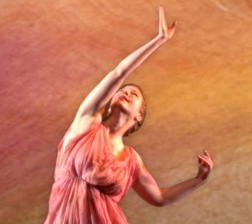
Monday, March 7, 2011

Duncan & Stanislavsky


Constantin Stanislavsky saw Duncan’s first Moscow concert in 1905 and later recorded his impressions of her in his autobiography My Life in Art.  He describes his reaction as that of a “newly baptized disciple,” and expounds, “when I became acquainted with her methods…I came to know that in different corners of the world, due to conditions unknown to us, various people in various spheres sought in art for the same naturally born creative principles” (Stanislavsky, My Life in Art).

Duncan in Russia
Duncan and Stanislavsky met when she returned to Moscow in 1908, and he reminisces, “we understood each other almost before we had said a single word” (My Life in Art).  Both Duncan and Stanislavsky crafted their performance arts through their ability to organically convert an internal, emotional impulse into expression.  Both artists were able to achieve a state of being present in the moment and imaginative circumstance of performance and to respond with either dialogue or movement to the textual or musical cues.  Both artists sought to create a reciprocal dialogue between life and art, and they maintained a correspondence continuing their dialogue about their performance methods.

Duncan's Moscow School
Duncan wrote to Stanislavsky, “Today, I worked all morning and put many new ideas into my work. Rhythms again. It is you who have given me these ideas” (Victor Seroff, The Real Isadora). Stanislavsky wrote to Duncan, “You have shattered my principles. After your departure, I kept looking in my art for the thing you have created in yours. It is beauty, as simple as nature” (The Real Isadora (by the way, this book is the only source where I have found English translations of parts of the Duncan/ Stanislavsky correspondence— when I was in Moscow in 2005, I requested to view the letters, which are housed in an archive at Moscow Art Theatre, and my request was denied)). Although Stanislavsky was unsuccessful in his attempts to bring Duncan's school to Russia, in 1921, when Duncan finally did establish a Russian school, her students were frequent audience members at Stanislavsky's Moscow Art Theatre productions.

Building for Moscow School 2005
Glimpsing the working dialogue between these two great artists is exciting. It feels kind of like being a voyeur through the lens of time. I wonder, at what point, they realized the parts they were mutually playing in the revolution of performance methods? I also wonder what texts future historians will use to gain insight into artists' creative relationships, especially as we continue to move into a paperless, digital age. Emails and texts have displaced old-fashioned letters as the primary means of written correspondence. But perhaps blogs, with their innate capacity to self-archive, will still be around to provide future historians some clue as to the creative practices and processes of artists of our time.

Look out for more ruminations on artists’ awareness of their own historicity in next week’s post—the Merce Cunningham Dance Company’s final tour is coming to Austin.

Monday, February 28, 2011

Impulse to Expression & Maturation, A Common Denominator of Theatre and Dance


Klytemnestra rehearsal
I've been thinking a lot about the relationship between dance and theatre as performance arts, especially this past week! Expect ruminations on my new collaboration with Misha Penton and Divergence Vocal Theater and thoughts on middle school one act play competitions to be posted here soon...

Okay—last week was busy! First of all, congrats to my middle school one act play performers, who took second place at the PSIA one act play competition, and are now headed for the state contest in Fort Worth in May. Since September, I’ve been coaching the five seventh-grade girls in David Campton’s Some of My Best Friends Are Smiths, a great play exploring the issue of discrimination and casting it in an absurd context. These girls worked hard and developed a strong ensemble, and I was beyond proud of their performance on Saturday.

In addition to daily one act play rehearsals, last week I began collaboration on another project with Houston’s Divergence Vocal Theater—a new opera Klytemnestra. In preparation for this project, we have been researching past productions that tell the story of Aeschylus’ Oresteia, including Martha Graham’s Clytemnestra. 

Klytemnestra rehearsal, February 2011
I love that Graham choreographed her Clytemnestra at the age of 65—one of the greatest legacies of modern dance is the opportunity for women to create and perform at all stages of life. Even in the recent New Yorker, Tina Fey laments the fate of actresses after 40, in terms of limited movie contracts and single motherhood.  And this is in the year 2011. Women in the performing arts are still fighting for career longevity, almost a century after Duncan gave her last performance at the age of 50, months shy of her tragic death. Of course, the longevity of her career was an anomaly in her day—and such longevity, for female performers, is still the exception rather than the rule.

Oddly, this seems true for both theatre and dance performers, for both actresses and dancers. And, yet, in both fields, there is a maturation of artistry that takes place over the course of time. Isadora’s sister-in-law, Margherita Duncan, writes of Duncan’s critics, “If they had stopped to realize that a long line is harder to draw than a short one, a long note harder to sing than a long one, a slow movement is harder to sustain than a quick one, they might have recognized that the change in Isadora’s work was not substitution, but evolution” (The Art of the Dance). I look forward to the day when mature female performers are sought after for the quality of their gesture and the depth of their understanding of human behavior, conveyed through their craftswomanship in performance. 

An impulse, a reason to move, to react, to respond is the common denominator of theatre and dance expression. I fell in love with Duncan when I realized that she shared the same understanding of intention in performance articulated by Constantine Stanislavsky— both arts teach us self-observation. We learn to understand our own unconscious impulses, and, perhaps, to interrupt those impulses. To make choices based on our self-understanding— and through those choices, to begin to craft, to live, life as art. That is the ultimate lesson I hope to convey to both my dance and theater students. And that is also the lesson I seek to explore through my current collaborative and creative processes.

Monday, February 21, 2011

Budgeting Education, Valuing Expression


Budget talk is everywhere. If you are in Austin, you know that the reality of balancing school budgets equals cuts to education in the form of school closures and job loss. The past few weeks have seemed pretty unbelievable as parents scour the books, picket, and protest the shutting down of schools in Austin’s Independent School District. As an arts educator, I’m used to the constant threat of cuts to the arts in schools, but right now, entire schools are being cut!

Tunics at the State Capitol (Austin)
As an Americans for the Arts supporter, my inbox has been full of warnings of pending votes in Congress on cuts to the National Endowment for the Arts, with urgings to contact my representatives and express my desire to save arts programming. I follow the steps, fill out the email form, and even personalize it to my perspective as an arts performer, teacher, scholar, nonprofit board member, and administrator--only to find out that the measure passed the House by a margin of 8 votes. If this stands, the NEA budget will decrease by close to 25% (or down $43 million from its current $167.5). Thankfully, the bill still hasn’t passed the Senate, and they begin consideration when their session resumes on February 28th. It’s not too late to contact your senator through Americans for the Arts and pledge your support for the NEA.

What would Isadora think about all this? I imagine she would encourage us to think about how, as a society, we are expressing what we value. The mark of value in a capitalistic economy is currency, money. We express value by how much we are willing to pay for particular goods or services. Prices are driven up and down according to supply and demand and the logic of the system is not influenced by the kind of values that make up a moral code. There is no inherent conscience in capitalism—if we are choosing to organize not only our national but, more and more, our world culture according to capitalistic principles, it is imperative that we not lose sight of elements of our human culture that teach creativity, critical thinking, and compassion for and consideration of other people and perspectives. Education and the arts are essential—let’s value them as such!

Where will we be if we continue to shortchange thought (education) and expression (arts)? From my perspective, if we do not preserve time, space, and opportunity for the development of thought and expression, freedom will atrophy.  What is freedom if we devalue critical thinking and place limits on our capacity to shape thought into expression through communication?

Duncan’s work was not just about personal expression, it was about making an argument for individual, creative expression as an inalienable human right. Duncan’s was not a passive perspective, and her courage and willingness to use both her body and her voice to express what she believed to be important is, perhaps, the most inspiring aspect of her legacy. Let's honor her and learn from her example by continuing in her (bare)foot steps!

Monday, February 14, 2011

Dancing for Joy and Transformation through Music


“There are perhaps grown people who have forgotten the language of the soul. But children understand. It is only necessary to say to them: ‘Listen to the music with your soul. Now, while you are listening, do you not feel an inner self awakening deep within you—that it is by its strength that your head is lifted, your arms are raised, that you are walking slowly toward the light?’ This awakening is the first step in dancing, as I understand it” (Duncan, The Art of the Dance).

When I watch my young dancers at the Girls’ School of Austin transform through movement and music, I understand what Duncan means. These dancers have an impulse to action, to movement, to expression.  They are unselfconsciously responsive to music—their footwork reflects rhythmic changes, their bodies slow down or speed up, they gesture broadly or find stillness and repose. My task as their teacher is not to teach them how to move, but to provide room and opportunity for them to dance with full-bodied expression through space. I offer them different musical rhythms and encourage them to notice how their bodies are responding—I offer shape and refinement to their natural impulse for gestural expression.

The result is a joyous transformation through music and movement that is a delight to experience, and we so enjoyed sharing with the grandparents who came to celebrate Community Day in honor of Valentine’s Day.  The program we danced consisted of two structured improvisations, enabling the dancers to explore freedom of expression, and two Duncan choreographies, the “Prelude,” and the “Tanagra Figures.” We sandwiched the learned choreographies in between the more free-form dances to encourage the girls to dance the learned movements with a sense of improvisational spontaneity.

Last week, I also had the opportunity to experience the masterful playing of pianist Emanuel Ax.  The all-Schubert program he gave last Thursday night at the Bates Recital Hall was breathtaking—or breath-giving, for he was very much in dialogue with his instrument. He played conversationally—there was a rhythm between listening and expressing, and his gentle touch provided the conduit through which the conversation flowed. I’ve never seen or heard anyone play piano with the quality of gentleness he embodied, and his ease enabled the more dynamic moments to explode without a forced willfulness.  Needless to say, I was dancing on the inside—and I must have been one of many, as the concert hall was packed. I can only imagine what it would be like to actually get to dance to his live playing. One can dream, right?

I highly value the opportunity to dance with live music, and am excited for my upcoming collaborations with Divergence Vocal Theater, so I can continue to explore the dialogue between dancers and musicians.  I am also excited to get my young dancers in a studio space, and I’ve officially booked at least one week of summer dance camp at Galaxy Dance Studios in Austin. Registration details will be up on my MB Arts website soon. In the meantime, feel free to contact me with any questions.

Monday, February 7, 2011

Tunics in the Breeze


“When we put on our tunics, we feel like magic,” said one of my dancers at the Girls’ School of Austin. “Really? I feel that way too,” was my reply.

I’ll never forget my first tunic. Dark purple silk, eggplant, and slightly heavy. I was taking a series of Saturday classes through the Isadora Duncan Dance Foundation in New York, predominantly taught by Cherlyn Smith. I bought the silk somewhere in Chelsea. I seem to remember getting a good deal on it, as it was the last of a bolt, and I sat in a coffee shop before class, one day, stitching together the two rectangles of cloth at the shoulders and side seams. I even had enough fabric left to drape over a couple of upended crates in my Inwood apartment.

Tunics in the Breeze!
The first time I danced in my tunic, something clicked. Was it the flow of the fabric? The sense that the silk provides an extra beat, a movement in response to the music, the visible echo of the ebb and flow of breath—and not just the dancer’s cycle of inhale and exhale, but the breath of motion, of life, of breezes that caress the earth? Or was it simply the magic that my young dancers have decided is just part of putting on a tunic?

It is true that Duncan removed her corset—that she danced full of breath and unconstrained by external constriction of her ribs and organs. That she brought a literal, physical freedom to female bodies, as well as freedom of expression, both artistically and socially. These are historic facts—interesting to consider and requiring imaginative effort from our twenty-first century sensibilities.

And yet, the power of the tunic is not limited to these turn-of-the-twentieth century historic conditions. The magic my young dancers feel is not a response to Victorian era restrictions. It is something else. A sense of possibility, of potential—that exploration of the inner creative landscape might yield wonders beyond the limited vision of our rational intellects. That movement, and breath, and music are tools for exploring this unmapped terrain. And, maybe, tunics heighten our perceptual senses just enough to realize the mysterious potential of this magical realm.

Monday, January 31, 2011

Beauty, Technology, and Colors in Motion™


Early modern dance artists wove multiple and sometimes seemingly contradictory influences into their dance works. For instance, they used terms such as “natural” to describe the style of their movement and advocated for a relationship between the human body and nature, celebrating seasonal cycles and an idealistic, perennial philosophical perspective.

"Sky," collaboration with Linda DeHart
Yet, at the same time, they incorporated some of the newest scientific theory and technological advances into their performance presentations.  Loie Fuller created fantastical moving images through innovations in costume technology and lighting design and influenced Duncan’s use of side lighting and warm colors.  Duncan may have mothered a “natural” dance technique, but she used contemporary scientific metaphors as evidence to support her argument for a movement technique based on the physics of the human skeleton, efficient movement patterning, and harmonious proportions.

We know that Duncan was inspired by natural forces, like the wind in trees and ocean waves, but Duncan did not limit her understanding of wave movement to visible manifestations of the phenomena. “All energy expresses itself through this wave movement,” she wrote, “For does not sound travel in waves, and light also?” (Duncan, The Art of the Dance). Duncan advocated rediscovering the embodied knowledge of the ancient Greeks, and, at the same time, she used contemporary physics metaphors to describe her dance art.

Shooting green screen footage for CIM
At the turn of the twenty-first century, we are again (or still?) in the midst of a technological revolution (evolution?). Our lives are being continually transformed by mobile technology, the internet, and digital media.  We are constantly bombarded by digital media and sound bytes, pecking at our attention, fracturing our consciousness, and encouraging us to give in to whirlwind multi-tasking and the accompanying high-stress high.

Is there any way to utilize these new technological mediums for meditative and restorative ends? To create beauty in the world? This is the question posed by the creative team of Colors in Motion™, spearheaded by visual artist Linda DeHart, a veteran creator of large-scale public art commissions and longtime practitioner of Noyes Rhythm (for more context on Noyes, check out October’s post “Forest Breathing in Nutley, NJ”).  DeHart’s latest project embraces the potential of new media to create atmosphere and transform space—and to do so with the goal of slowing people down, encouraging them to breath, and inviting them into an experience of tranquility, peace, and beauty.

Teaming up with artists from a variety of mediums, including filmmaker Christopher Graefe, poet Jeff Volk, composer Josh Hummel, me as dance artist, and arts integrator and Noyes Rhythm practitioner Susan Bayley, DeHart and Colors in Motion™ are crafting visual and sensorial art experiences that heal and transform. These multimedia experiences are effective on the small screens of phones and computers and are awe-inspiring as large-scale, full-wall architectural installations. Check out the Experiences page of Colors in Motion™ for samples of this innovative work or subscribe to receive monthly online experiences through Touchstone, art that changes people’s moods in public spaces.

Monday, January 24, 2011

Duncan Dance, Pedagogy, and a Progressive Perspective


We know that education, not just dance education, was supremely important to Isadora. She envisioned dance as a vehicle for revolutionizing general education and as the means for educating the whole person, from a developmental perspective.  One aspect of the legacy of Duncan dance is the idea that every body has a right to experience the joy and freedom of expressive movement. Duncan envisioned the freedom to dance as a human right. Now that would be a pretty radical platform for a human rights organization!

Winter Workshop, Nia Moves, Houston
When I was a grad student at the University of Texas at Austin, we read an excerpt from sociologist Barbara Ehrenreich’s Dancing in the Streets: a History of Collective Joy. Although critics of the book cite her lack of engagement with the work of contemporary dance history scholars and theorists, she does present a compelling portrait of the power and potential danger inherent in the unconstrained bodily movement of the masses. Most interesting is her observation that dance movement can be contagious and, in some cases, it can be hard to stop.  Duncan certainly waxes eloquently about the element of Dionysian ecstasy she experienced through the dance, and her idea that dance movement can create an altered and uplifted state of consciousness pervades many contemporary ecstatic movement practices.

Student, Winter Workshop
And yet, there is kind of an irony in Duncan dance—the work advocates for universal access to the tools of expressive movement, but the technique itself is quite specific and not necessarily easy to execute. That doesn’t mean it is inaccessible to a wide range of bodies, experience levels, and ages, but it does mean that there is a specific way Duncan coordinated movement in her dances and that daily practice, or training over time, is required to fully embody the movements in her choreographies.

It was this paradox of Duncan dance that I held in mind when my cousin Bill asked me whether I envisioned training a select, privileged few to dance the movement to perfection or whether I would rather share this dance work with the masses. Of course, he already had presumed a specific answer when he posed the question (after dubbing me an evangelist of Duncan dance, he was advocating for the teach-the-masses approach).  Bear in mind, this was after I found out that we share an ancestor who died, as a public figure, in the midst of giving a speech about the importance of well-funded public education, so I suppose I might come by my bent towards educational evangelism honestly!

Winter Workshop, Nia Moves, Houston
I do want to share this work with a broad swath of people, and I very much come from an egalitarian perspective when it comes to this work. Yet, I also have deep respect for the subtlety and integrity of Duncan’s dance technique. Having taught a smattering of guest artist residencies and one-time workshops, I realize that I need to cultivate a space to teach this work to an adult population on a more regular basis. There is just so much depth in this movement work, and to teach an introductory class barely scrapes the surface.

Student, Winter Workshop
It was so gratifying to share this movement last weekend in Houston—and to have such a great workshop turnout and with so much interest expressed in experiencing more Duncan dance! I’ll be back in Houston for another performance event in the spring, so hopefully there will be opportunity for a spring workshop there in a few months. In the meantime, the spring semester has just begun for my youth modern classes at Tapestry Dance Academy, my Modern Dance I course at Austin Community College, and for my horde of K-2 Duncan dancers at The Girls’ School. Austinites, if you are interested in a weekly, adult Duncan class, let me know. I’m looking for space and hope to announce details soon!